Twilio is a cloud communications platform that enables developers to build, scale, and operate real-time communications within their software applications. It provides APIs for voice, messaging, video, and authentication services, allowing businesses to integrate robust communication capabilities seamlessly.
Refer to our website for the list of metrics and attributes available in Dataddo.
Refer to Twilio's official documentation to see all available endpoints from the Twilio API.
Authorize Connection to Twilio
In Twilio
To authorize your Twilio account, you will need your account SID, and auth token (= API token.
- In your Twilio account, on the dashboard, scroll down to the Account Info section.
- Copy the value of the Account SID and Auth Token.
In Dataddo
- On the Authorizers page, click on Authorize New Service and select Twilio.
- Fill in the following fields:
- Account SID: Your Twillio account ID.
- Auth Token: Twillio API key.
- Rename your authorizer for easier identification and click on Save.
How to Create a Twilio Data Source
- On the Sources page, click on the Create Source button.
- Select the connector from the list and name your data source.
- On the Dataset step, select your dataset.DATADDO TIP
If you're unsure which dataset to select, use the search bar to look for datasets with the desired attributes or metrics.
- On the Account step select your authorizer from the drop-down menu.Didn't find your authorizer?
Click on Add new Account at the bottom of the drop-down and follow the on-screen prompts. You can also go to the Authorizers tab and click on Add New Service.
- On the Attributes and Metrics step, select the metrics and attributes you want to extract.
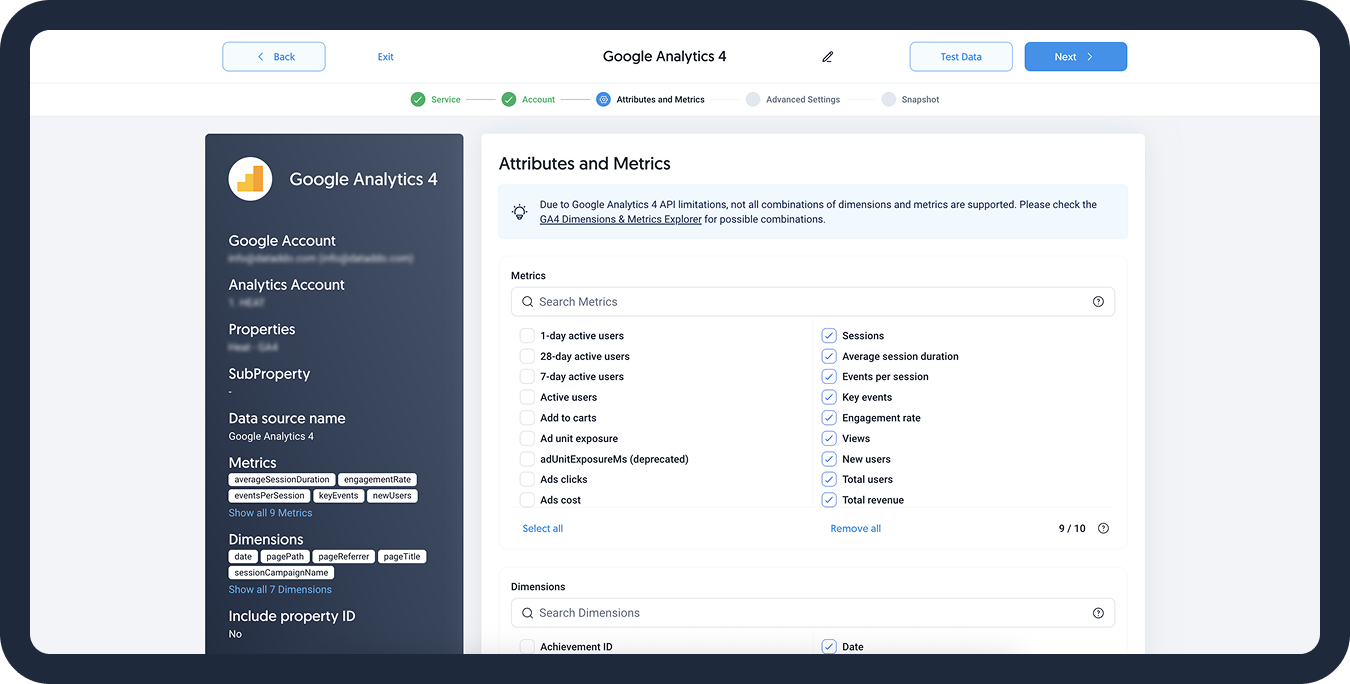
- On the Metadata step, select which metadata fields such as extraction time to add to your data.
- On the Snapshot step:
- Configure your sync frequency or click Show advanced settings to set the exact synchronization time.DATADDO TIP
To load historical data, refer to the Data Backfilling article.
- [Optional] Enable the Allow Empty Data Extractions toggle to allow the extraction when no data is available.
- Configure your sync frequency or click Show advanced settings to set the exact synchronization time.
- In the top-right corner, click Test Data button to preview extracted data. Adjust the date range for specific time frame.
- Click on Save and congratulations, your new data source is ready!
Troubleshooting
Data Preview Unavailable
No data preview when you click on Test Data might be caused by an issue with your source configuration. The most common causes are:
- Date range: Try a smaller date range. You can load the rest of your data afterward via manual data load.
- Insufficient permissions: Please make sure your authorized account has at least admin-level permissions.
Related Articles
Now that you have successfully created a data source, see how you can connect your data to a dashboarding app or a data storage.
Sending Data to Dashboarding Apps
Sending Data to Data Storages
Other Resources